
🟡 Neuroscience Education for Coaches, accredited by the ICF for 40 hours of Coach Education Credits
You're good at what you do, and your coaching work already goes deep.
Take it a step further with robust neuroscience
and be able to charge accordingly.
Built for coaches, practitioners, psychologists, business owners and directors who want the evidence base that deepens their practice - and the credibility that lets them charge what it's worth.
40 ICF CCEs | Small-Group Cohorts | Neurodivergent-friendly | October 2026 Start

"If you're ready to challenge yourself, learn from an outstanding teacher, and add evidence-based neuroscience to your coaching toolkit, this course is an excellent investment.”
Jacinta Noonan,
Corporate Trainer, Speaker & Transformational Coach

We believe that great coaching starts with great coaches, and that coaching should be held to the highest professional standards possible.
That’s why we’re delighted to announce that our certificate in Neuroscience Education for Coaches has received 40 ICF Continuing Coach Education (CCE) credits.
The right education doesn’t just make you a better coach. It can strengthen your positioning, increase your credibility, and give you a powerful point of difference when communicating the value of your coaching to prospective clients.
THE COACH THIS IS BUILT FOR THOSE SAYING:
"I already know how to create change with clients. What I want now is to understand the neuroscience that explains why it works, and what it would take to go even further."
You're already a skilled practitioner with an established practice. Your coaching creates real change, working at the level of identity, insight, and genuine transformation. You also have the track record to prove it.
What you're looking for now is not a foundation but a practical understanding of the mechanisms behind the work you already do well. To be able to say, with precision and confidence, why a particular intervention works, what is happening in the brain when a client shifts, and how to go even deeper when you need to.
You're curious about the science, not intimidated by it. You've already read widely on coaching and to some degree around neuroscience, the latter of which ypu've found to be either too shallow to be useful or too academic to translate into practice.
You're looking for something that meets you at the level you are already working at.
If that's you, then this programme was built with you in mind.
THE COURSE POSITIONING:
The Goldilocks of neuroscience training
Most neuroscience training for coaches sits at one of two extremes. Neither is built for practitioners already working at depth.

Too academic
Rigorous but unreachable
Academic neuroscience is precise, but it was not designed for application. The research sits behind jargon, and even when you can follow it, you cannot translate it into what to do differently in a session on Thursday.

Just right
Rigorous and usable
Built specifically for coaches who ask "what does the evidence actually say?" You will understand the mechanisms, not just the metaphors, so you can apply them precisely, explain them confidently, and deepen the quality of your coaching.
Too simplified
Accessible but hollow
Pop neuroscience offers neat, shareable snippets. Strip away the metaphors and there is often no substance left. You are coaching far beyond Instagram neuroscience, and your CPD should be too.
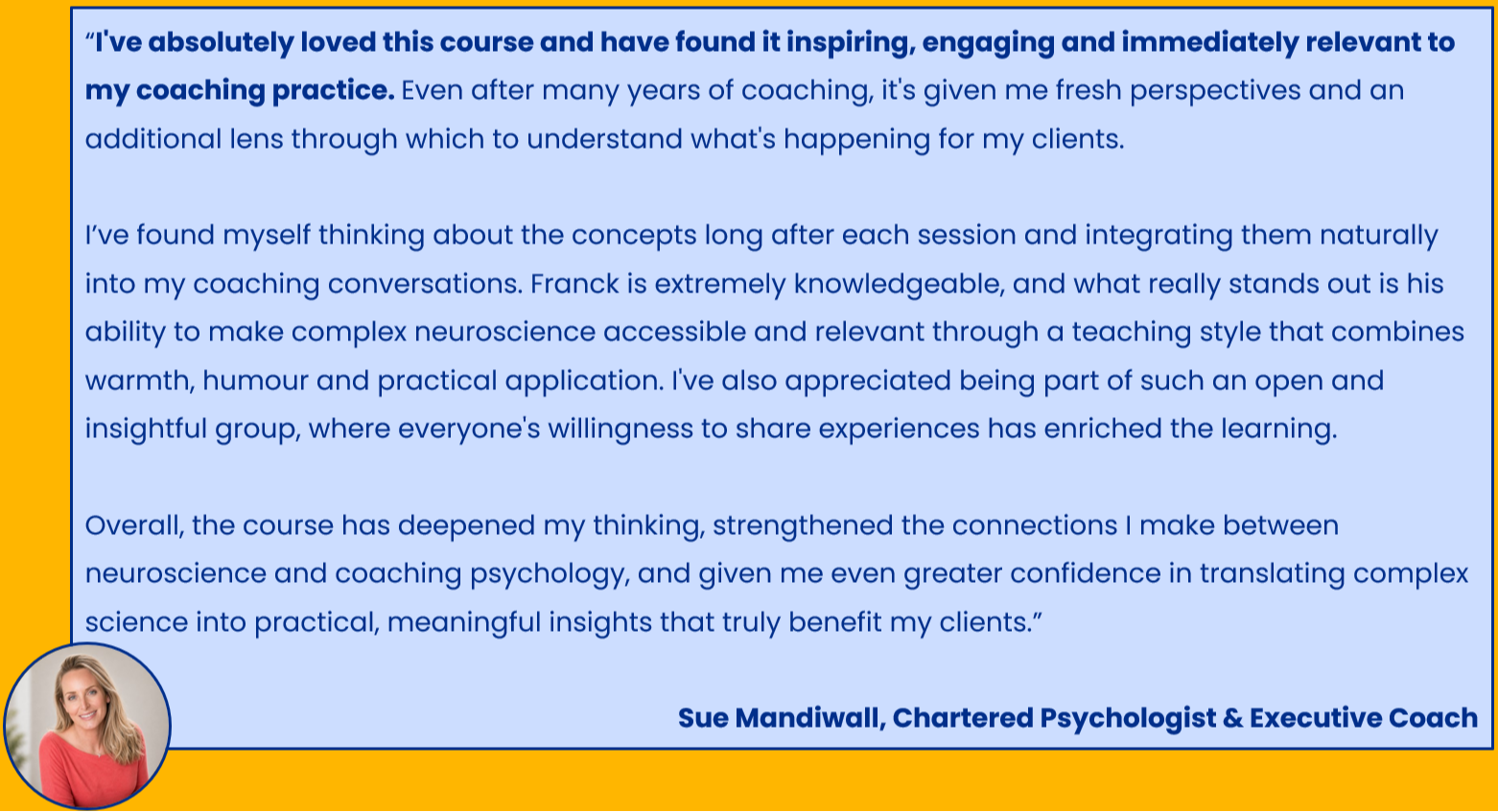
Sue is an experienced Chartered Psychologist with renowned clients. This neuroscience certificate has given her even greater confidence and a toolkit to match:

✅ Suitable for:
- High-performing practitioners, psychologists, business owners and directors who want the evidence base that deepens their practice - and the credibility that lets them charge what it's worth.
- ICF / AC / EMCC-aligned coaches with 3+ years of coaching experience
- Practitioners who are genuinely curious and hungry for deeper understanding, and are already experienced enough to know what they don't know
- Those with strong coaching fundamentals in place such as presence, deep questioning, holding space, regular supervision
❌Not Suitable for:
- Life coaches without formal training or credentials
- Coaches who are constantly "too busy" to dedicate 5 hours per week to the programme
- Those who are too nervous to try out new coaching concepts live on and with other coaches during sessions
- Those looking to "train the trainer" or launch their own course on the subject
- Coaches happy to put in the bare minimum of attendance and claim their certificate
- Anyone wanting to learn neuroscience to sound impressive, rather than to become a better coach
- Those who want quick hacks or bite-sized snippets
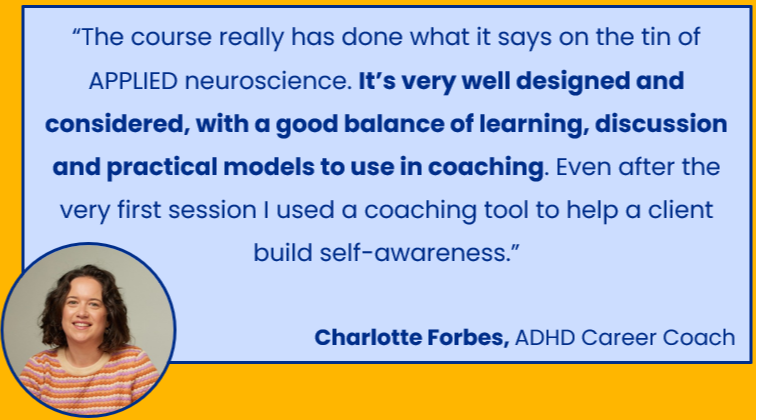
Charlotte had already completed a neuroscience course with a well-known neuroscientist, yet still found this both valuable and applicable from day one.
EVERYTHING THE PROGRAMME INCLUDES
- 12 x live 3-hour sessions
All sessions for Cohort 002 take place from 9.30am-12.30pm (UK time).
Dates are as follows:
- October: 13th, 20th,
- November: 3rd, 10th, 24th
- December: 1st, 8th, 15th
- January: 5th, 12th, 19th, 26th
- Note that there are no sessions on 6th October, 27th October, 17th November, to allow for Half-Term and breaks between modules.
- Research-backed content aligned to ICF coaching competencies
Every session connects a range of neuroscience evidence and concepts directly to ICF coaching competencies and how you coach. This isn't pseudo-science or science for science's sake. It's real neuroscience that makes you a better coach.
- Neurodivergent-friendly study support material
Clear, structured notes and resources for every session. Designed to be accessible, practical, and easy to revisit when you need them.
- Certificate of Completion (40 ICF CCEs)
Recognise your achievement with a new certification for you to boldly promote your new-found neuroscience knowledge!
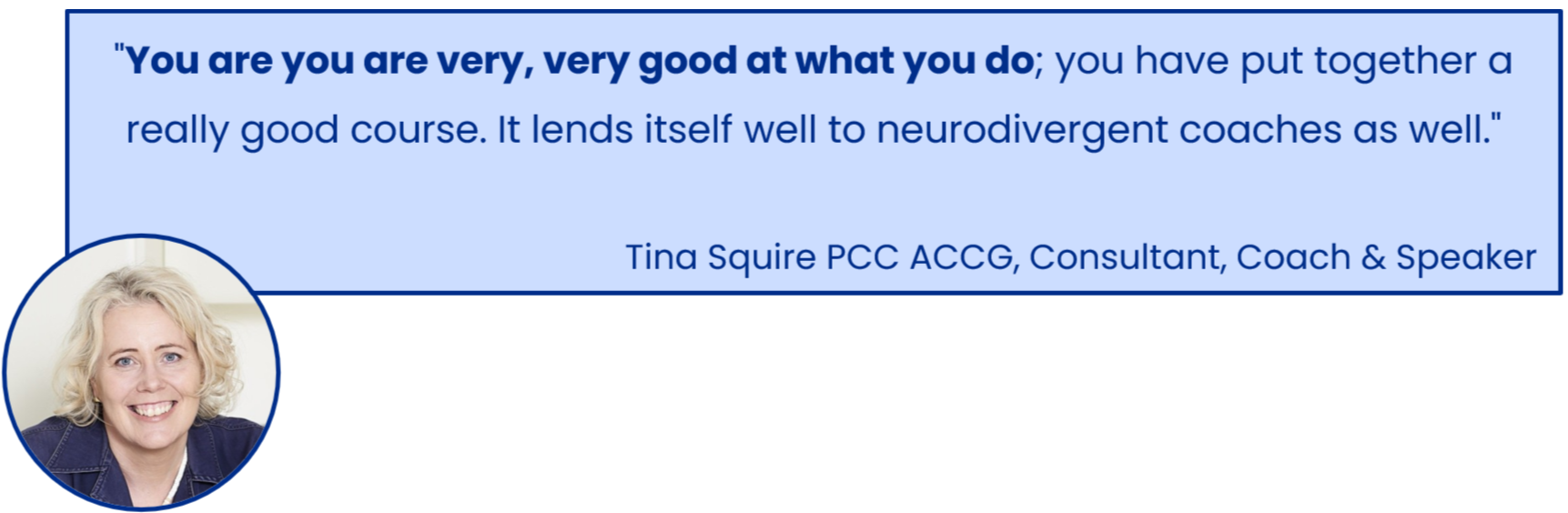
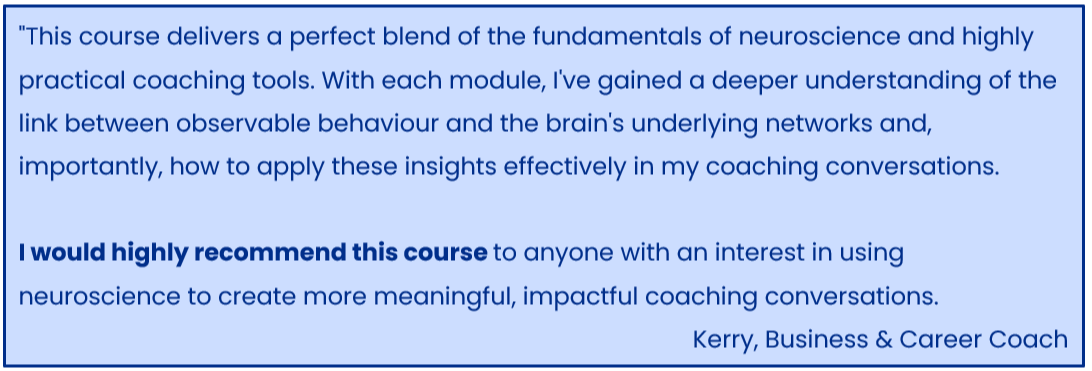
Coaches with thousands of delivered hours have this to say:

Why work with Franck?
Franck is an ICF PCC with almost 2,000 coaching hours delivered and many more thousand hours studying neuroscience and human behaviour. He's also currently completing an MSc in Applied Neuroscience - averaging a Merit so far - through the Institute of Psychiatry, Psychology & Neuroscience (IoPPN) at King's College London, ranked 2nd in the world for psychiatry and psychology (Source: US News). On top of that, he's been invited onto the research advisory board of Anne-Laure Le Cunff (author of Tiny Experiments) for her research around ADHD & hypercuriosity.
The investment
Pricing is the same, whichever option you choose:
3 x monthly direct debits of £600 (Most Common) OR 1 x £1,800 (Simplest)
This is designed to be as accessible as possible, given the high-value, research-backed content that comes with a mix of live training and anytime materials. Designed with neurodivergent learners in mind, you'll strengthen your work with PCC-level, neuroscience-informed coaching you can use across your work.
From January 2027, pricing goes up to £2,400 to reflect the incredible value delivered.

Secure your place and sign up today
Oct '26 - Jan '27
£1,800 or £600.00/month for 3 months
Cohort 002 has its sessions on a Tuesday,
9.30am-12.30pm (UK time)
- October: 13th, 20th,
- November: 3rd, 10th, 24th
- December: 1st, 8th, 15th
- January: 5th, 12t, 19th, 26th
- Note that there are no sessions on 27th October, 17th November, or over Christmas to allow for Half-Term, break between modules and time for natural rest and recovery.
Can't make the October start?
Cohort 003 will most likely have its sessions on a Thursday, 9.30am-12.30pm (UK time).
Exact dates and times are TBC, but likely to start on Thursday 28th January 2027.
BEFORE YOU APPLY:
Common Questions
What does the syllabus cover?
Is this right for me if I'm a neuroscience newbie?
When do the live sessions take place?
Is this one of those mass-learning events with hundreds of people?
How much time will this take?
Will this course look at neurodiversity?
I can't make the October cohort dates. Will there be a future cohort?
What if I can't attend all twelve live sessions?
I still have questions...
The neuroscience your
practice has been waiting for.
Intentionally capped at twelve coaches per cohort, to prioritise depth and connection. Your coaching work already goes deep; now understand why it works and take it one step further.